

One of the most surreal and gratifying experiences of entering my late 20s is that my peers suddenly wish they read more. Let me tell you: my life at age twelve would’ve been significantly improved if this had been the case back then.
Beyond picking up books they’ve vaguely heard about that sound vaguely interesting or important, though, they seem unsure how to actually go about this goal.
I read a lot—somewhere between 50 and 130 books in any given year—and I’ve kept up that pace for the last 17 years, which is when I started reading adult books. And before you ask: no, I don’t have a job that requires reading, and no, I don’t count a book toward the total if I only skimmed it. (Or if it’s a re-read. Or if it’s very short. Etc.)
I don’t claim to be good at most things (or, really, anything else), but when it comes to books in particular, I consider my opinion to be above average.
But first, a reassurance.
Reading is not a moral imperative
I obviously would not read this much if I didn’t get something out of it. In fact, over the years, I’ve gotten a lot out of it. I also think long-form non-fiction in particular is unmatched for rigor of thought compared to pretty much any other medium for learning. (Yes, including Substack essays, sorry.)
But that still doesn’t mean you have to do it.
A great deal of the veneration of books and reading seems to come from status games among well-educated upper middle class types.
But here’s the thing: you do not have to play.
Maybe you don’t read as much as you wish you did not because you lack time, or because you haven’t found your niche yet, but because… you just don’t like it.
And that’s fine. A lot of people don’t actually like it. Even a lot of the ones who pretend to. Even a lot of the ones who pretend even to themselves.
And of the ones who do like reading, many (most) are not reading rigorous non-fiction or quality literature—they’re reading commercial bestsellers, which are generally entertaining and not that deep.
Which, again, is fine. I love reading for entertainment too.
But you do not need to feel bad about not joining them. A bingeable crime-thriller TV series is not meaningfully less deep than a bingeable crime-thriller book. Ditto for much fantasy, romance, chick lit, action, etc. If your preferred mode of entertainment or study isn’t books, just do something else.
In a pinch, if you still want to keep up, I recommend reading How to Talk About Books You Haven’t Read by Pierre Bayard and calling it a day. (I haven’t read this book, and so don’t know how to talk about it—I’m just going off the title.)
Or just admit you haven’t read whatever book people are calling necessary this week, and ask lots of questions when someone brings it up, comforted by the knowledge that there’s, like, an 80% chance it’s not actually very good.
The most important thing to get right
You need to pick the right books for you. This solves a surprising number of seemingly unrelated reasons for not reading more.
Note that this is distinct from whatever is being marketed most heavily this week, or any imposing classics you may feel you “should” read. It’s also different from whatever an interesting podcast guest or extremely well-read blogger happens to recommend.
Reading also carries an opportunity cost—both for the time spent reading instead of doing something else, and for reading one particular book instead of another. This latter cost is especially relevant the fewer books you read. At 100 books a year, I already feel I have to be picky; if you have the energy for under five books per year, you ought to be very choosy indeed.1
And yet, perhaps unsurprisingly, the opposite often happens. I’ve noticed that friends who read less tend to latch onto whichever book is most immediately salient or curiosity-provoking—not because it’s a good fit, but because they aren’t in the habit of seeking out books and don’t have a process for choosing them. Instead, they might be better served by actively protecting whatever limited slots they have for books that actually suit them.
But how does one discover what those books are? There are so many out there, and this can be genuinely hard to figure out—especially since the books we respond to most strongly sometimes surprise us.
Here’s how I think the process can be bootstrapped.
Know why you are reading
Say you’ve internalized that reading is not a moral demand, and that you don’t need to participate in whatever status game your friends are playing, but you want to read more anyway.
Why?
Personally, my main reasons are:
To see the world better. To that end, I read non-fiction that improves my ability to notice and appreciate what I already perceive.
To understand how people saw things in the past. Related to the above, I find it hard to locate my own assumptions without encountering very different ones. Books, both fiction and non-fiction, are especially good for this. This is also one area where books are clearly better than other media like film, or even music, simply because texts go farther back.
For love of beauty. Reading beautiful prose is something I find inherently rewarding.
For entertainment. I’m not easily gripped by other media, but for whatever reason I find books incredibly absorbing, and much more relaxing than other activities that put me in a flow state.
I realize this can be hard to articulate, so here are a few more possible reasons: to get acquainted with the canon; to learn more about a particular topic; to challenge your own ideas; to become more articulate; to improve your life in a tangible way; to learn a skill; to train your ability to focus; to have smart things to say in group discussions; to improve your vocabulary; to learn a new language; to frame a problem better; to keep up with current events; to enjoy a particular aesthetic impression or mood; to encounter other cultures and perspectives; to improve your cultural literacy. Or, of course, because you suspect there might be something out there for you in books, and you may or may not know how to find it.
This list isn’t intended to be exhaustive, but I hope it helps clarify what you want out of a book.
(One small warning, though: trying to read for everything at once—self-improvement, cultural literacy, intellectual challenge, and pure pleasure—won’t help you filter or prioritize. Try to narrow it down to the most important ones if possible.)
Beyond that, consider what themes or dilemmas you’ve been thinking about lately. For example, over the last couple of years I’ve noticed that, as a secular person, I had a very shallow understanding of religious viewpoints, and that this was severely limiting my ability to understand other cultures and historical periods. I’ve also been thinking about the phenomenology of hallucinations and delusions, both in the context of mental illness and in healthy people.
Consider which news stories reliably catch your attention, and why, or which aesthetics you’re most drawn to. Even noticing whether you tend to prefer novels of ideas, aesthetic vibes, or a gripping plot can help you avoid a lot of duds.
Troubleshooting
You choose books that are too hard
One extremely common pitfall I see in peers who want to read more is that they choose a difficulty level that’s too high before they’ve built any momentum or stamina, or accumulated a mental catalog of literary references. Their reading speed is also usually slower than it would be with more practice, and since the experience of pacing is partly subjective, this makes all books feel more boring.
Some “classics” are huge slogs. Many others require an enormous amount of prior reading to really pay off. No matter how smart you are, do not expect to enjoy these right away—even if your stated goal is to get well acquainted with the classics. This is setting yourself up for failure.
Note that this problem manifests in many ways, because “hard” can mean a lot of different things. One common version is just not finding books very absorbing. Another is systematically stalling partway through. Yet another is finding most books pretentious, because you’re unwittingly choosing ones that primarily reward a taste for enjoying prose style for its own sake—a preference many people never develop, even if they read a lot.
In all cases, the solution is broadly the same: match the books you read to your current level and interests, not to your aspirations.
Choose books that are entertaining and written to hook the reader. Choose books that feel as fun as whatever you’d normally do instead. Choose books that start paying off early, whether through plot momentum or ideas. Choose books with short chapters. Choose books you can skip around in, where putting them down for a while and picking them back up doesn’t feel like a failure (e.g., short story or essay collections, aphorisms, reference texts, etc.). Choose novellas or novelettes. Choose narrative non-fiction instead of dry treatments of the same subject. Choose books that were not considered experimental or avant-garde when they first came out.
View the first thirty or so pages of a book as a test rather than a commitment, and feel free to stop there if you can already tell you have little motivation to read the rest. If you’ve stalled on a book, stop reading it immediately, make a note of it, and come back later—once you’ve improved at reading—if you still feel it’s worth it. You can also try something shorter or more accessible by the same author, which is often a better entry point than their more famously difficult work.
And so on.
None of this is a guarantee that you’ll end up enjoying reading. But it’s a much better strategy than picking up some inscrutable tome that sounds interesting or important and hoping for the best.
(At the end of this post, I’ll provide a short, extremely non-exhaustive list of books I’d recommend avoiding if you don’t read regularly, along with a companion list of more approachable books that are still substantive.)
You choose books that are too easy
At the other end of the spectrum are people who read regularly but stick to low-ambiguity commercial fiction, especially the bingeable kind. Unlike choosing books that are too difficult, this isn’t really a problem. In my experience, people with this habit are generally happy with their choices. If that’s you, then there’s no particular reason to change.
But on the off chance that you’re a member of this group I’ve never met2—someone who reads a lot of bingeable commercial fiction and feels bored or stuck in a rut—I’d recommend perusing the classics of your preferred genres. You might also try seeking out similar books with greater syntactic difficulty, a slower pace, or that ask more of the reader in terms of thought and interpretation.
You’re stuck on the trend cycle
There is always some book that’s being well promoted. That doesn’t mean it’s right for you.
Here’s a taxonomy of some of the means of finding books that can lead to systematically reading ones that are overrated:
Someone has an idea they want to do a publicity tour for. And they wrote a book about it! Now you and everyone else have heard of it. These books are often a digestible presentation of their subject, but they’re rarely very original, and they may not be the best treatment for you. And while we’re at it, are you even interested in the subject?
Someone won a Nobel Prize! They’re probably a good writer. This still doesn’t mean you’ll get much out of reading them, especially if the work in question is “books for book nerds” and assumes a fair amount of context or prior reading, which is often the case.
This work of fiction is selling lots of copies! While this is usually, but importantly not always, a guarantee of readability, it’s no guarantee of quality, and more importantly, no guarantee that it aligns with what you’re trying to get out of reading. (As a side note, if you do want to read bestsellers and English is your main reading language, the American Bookseller’s Association IndieBound Bestsellers list tends to have more varied and higher-quality picks.)
You’re in a book club. Tastes skew politely intellectual: we want something discussable—maybe even a little edgy—but not something that will offend. We’ll probably land on something contemporary that’s marketed as “important,” or whichever classic has won this month’s relevance lottery. (Maybe it even won a Nobel Prize!)
A new film adaptation just came out. Everyone knows the book is better, though. Why don’t you read it first? Or after? Or are you just one of those shallow people who doesn’t let a film release schedule dictate their reading preferences?
Despite my barbs, none of these are terrible ways to figure out what to read. I bring them up mostly because they’re suboptimal and encourage shallow dabbling. They also leave your taste vulnerable to being governed by whatever books publishers have recently decided to put a lot of money behind—which, to be fair, is often decent. The question is simply whether, given your limited number of reading slots, this is really the best use of them.
Depending on your media environment (read: social class), what’s trending will look different for you. But no matter what it is, I want to remind you once again that you don’t have to read it.
The next most important things to get right
Choosing what to read is the most important part. But that doesn’t mean it’s the only one. Below are a few more assorted considerations (which may or may not overlap with choosing the right books.)
Life is hard
In some cases, you may have a life situation that makes reading more, especially as a new habit, genuinely difficult. I don’t know if there’s a remedy for this, I’m afraid. If there is, it’s outside the scope of this post.
But note, too, that not being in an obviously hard life situation doesn’t mean you have a lot of unused capacity. I’ve noticed a trend where people try to reduce screen time by replacing it with non-digital “productive” hobbies. Where this often fails is in assuming that you can, in general, replace a restful activity with a more taxing one. If reading feels demanding, you can’t expect it to replace rest time.
To the extent that there are solutions to this dilemma—and there may not be, for you—the first is to rest more thoroughly. Some activities only feel restful in the moment but are actually fairly taxing, like scrolling social media feeds.
It also helps to notice that there are trade-offs in how you spend your attention, even when everything involved feels “light.” Activities like reading Twitter, Substack, or the news, or listening to podcasts, tend to draw on much of the same cognitive capacity as reading books. This took me a while to internalize, especially since many people who say they “don’t read much” are in fact consuming a huge volume of text in other formats. My personal preference is to preserve the capacity for books by avoiding these activities where possible, which partly explains why I’m able to get through more of them.
Another possible solution is, once again, to choose more suitable books. Pick books that are entertaining or restful. Pick books of aphorisms or short poems that you can read in five-minute chunks throughout the day. Above all, pick something you enjoy.
If you can’t focus more generally
Maybe your difficulty focusing extends beyond books and into other areas of your life.
To be honest, I’ve never struggled much with this myself, so I don’t have a lot of firsthand insight. My impression is that in some cases it’s about habit formation; in others, about lowering expectations for how much sustained productivity you can squeeze out of a day; and in a minority of cases about conditions like ADHD, which may benefit from medical intervention.
I did once have an acquaintance who dealt with mental drift by listening to the audiobook of a text while reading it, which struck me as a clever workaround. Moving your phone or other smart devices to another room might also help.
And finally—yes, you guessed it—pick different books. Two avenues I’d especially recommend if you struggle to focus in general are flash fiction and aphorisms. And, of course, there are self-help books aimed specifically at this problem. I haven’t read any, because, as I said, it’s not my particular issue, but you might try Four Thousand Weeks by Oliver Burkeman or Atomic Habits by James Clear, both of which look promising.
If you read slowly
Reading slowly makes reading less fun.
Unfortunately, some of this depends on cognitive architecture and isn’t really subject to change. Fortunately, you can usually still improve within your own limits.
The single biggest factor is practice: the more you read, the easier reading will feel. This, in turn, opens the door to slower-paced and more syntactically challenging books, which is part of the reason I recommend leaving those for after you’ve established a regular reading habit.
There are also a few techniques that can speed things along. Tracking the words you read with a finger is helpful for some people. Avoiding vocalization in your head as you go will also increase speed, though I wouldn’t recommend it if it comes at the cost of enjoyment. Reading also becomes more fluent if you chunk words: that is, read one or several words at a time instead of going letter by letter.
Selective skimming can work well, especially for non-fiction. If I’m reading a book that’s partly within my existing knowledge and partly new, I’ll often skip the remainder of a paragraph (or, in more extreme cases, an entire section) once it’s clear the opening is covering familiar ground. Of course, I may miss something by doing this, but I’ve tried it both ways and, for me, the benefit usually outweighs the cost.
I’d also recommend getting an e-reader, regardless of your reading speed. The first book you read this way may feel slower, but over time it tends to speed things up—partly because you can control font size and backlighting, and partly because it keeps text formatting consistent from book to book. It also lets you carry your book with you regardless of length.3
If you don’t get much out of what you do read
Often this problem is solved by choosing more suitable books, especially ones that more clearly engage with themes or problems you’re already interested in. I’d also recommend books that foreground their own ideas or questions, like much speculative fiction.
That said, many books also become more rewarding once you start getting a bit more out of them. One useful shift is to treat details differently than you might in other media. While details can be incidental in film, they’re rarely incidental in a book.4 In addition to having a plot, many books are also exploring open-ended themes through that plot, as well as through their choices of voice, structure, and style. If you haven’t already, it can be worth asking what those themes might be for any book you’ve enjoyed. This can also make it easier to locate other books that are likely to resonate in similar ways.
It can help to talk about what you’re reading, ideally with someone else who’s read it. If that’s not an option, a podcast episode about the book can serve a similar function.5 (I still wouldn’t recommend reading along with all of a podcast’s picks, for all the reasons discussed above.)
Discussing a book with your favorite LLM can also be useful, not to be told what to think, but to help clarify what you think. I’ve gotten the most out of this with books I don’t like but that many other people do: trying to articulate what doesn’t work for me, and what might have worked better, has often sharpened my sense of taste.
Miscellaneous tips
Below are a few bits and pieces that didn’t fit cleanly into any of the above.
Try audiobooks. Yes, this does count as reading—though no, it won’t make it easier to get through whatever dense piece of pretension you feel you should read. Consider that a feature rather than a bug.
Sometimes you’ll get more out of reading a summary or commentary on someone’s work than the work itself. This is especially true for philosophers or social scientists writing long ago, and doubly so if they’re famous enough to have generated a large secondary literature.
On the other hand, if you’ve already done this and decided you find a particular thinker interesting, I’d encourage you to follow up with some of their actual work. It may contain details that didn’t make it into the summary, and the devil is often in those.
Choose translations carefully. Often there’s one obvious pick, but especially for older classics there may be many to choose from. I’d urge you to pick a translation that aims to create a good reading experience, even if it isn’t the most literal. If it’s a play, it’s also worth seeking out a translation that’s actually been performed.6 If you find the book worth rereading, that’s when switching to a more literal translation can pay off.
Reread things. If you feel like rereading something, it’s probably a good idea, especially if it’s been more than a year. You’ll remember more, read faster, and often get more out of it. Some books are meant to be returned to, the way you return to a favorite song.7
If you do want to understand Western literature better, the single highest value-for-effort thing you can do is to read Genesis—especially if you’re secular. Most biblical references are from this one book, and as a bonus, it’s a lot weirder and funnier than you might think. The King James translation was particularly influential, though it’s not the easiest to read.
How to pick them
So you know what you’re looking to get out of reading. Maybe there’s even a particular topic you want to learn about, or an aesthetic you’d like more of. And you know which hurdles to watch out for.
Now what?
So far, I’ve offered a lot of advice about how to choose books in principle, and very little about how to actually find them and sift through the options in practice.
If you happen to have someone in your life who’s both very well-read and aware that their own taste is not right for everyone, asking them is a great place to start.8 (Note that the second criterion is much more important than the first.)
But say you’re not so lucky. What then?
Online sources
There are a couple of online sources I like to use. The first, and perhaps most obvious, is Wikipedia, which hosts lists of books by genre, period, setting, or theme. This works best if you already have some sense of what you’re looking for, since the lists themselves are usually broad rather than curatorial.
My favorite site for this purpose, though, is Five Books. It hosts interviews in which authors or other specialists recommend five books on a given topic, along with their reasoning. Some of the picks are niche, but that’s part of the appeal. I’d recommend searching for books you already know you like and seeing whether they show up on any lists; otherwise, browsing the archive can be a good way to stumble onto new directions.
One thing I’d caution against is relying too heavily on recommendation algorithms on sites like Goodreads and StoryGraph. These tend to lean heavily on surface-level similarities rather than shared themes or underlying structure. For example, I love The Great Gatsby, and as a result I might get recommended other books that are superficially similar (rich people in the Roaring Twenties) rather than books with a comparable architecture, like classical tragedies.
LLMs
LLMs can be a useful tool to find books, especially if you already have a decent sense of what you want to get out of reading.9 I’ve gotten the most value from them when I had a very specific topic or question in mind and was struggling to locate the right book, or when I wanted to build a small, custom reading list around a philosophical issue I’d been thinking about for a while.
Last year, for example, I noticed that many history books I’d read contained some version of a “witch hunt” motif: a majority turns on a minority group, often with the aim of protecting children, convinced that it’s acting morally. These episodes tend to age badly, but at the time they feel righteous and obvious. What I wanted to understand wasn’t just that this happens, but what it feels like from the inside, and how it emerges from ordinary social behavior. I had trouble even knowing what search terms to use, because so many books explain the phenomenon through higher-order abstractions like “bigotry” or “outgroup hostility,” which isn’t what I wanted at all. After some iteration with ChatGPT, during which I first had to clarify my own thinking, I was pointed toward Violence: A Micro-sociological Theory by Randall Collins. From the blurb alone, I could tell it was exactly what I’d been looking for. It ended up being my favorite of the 130 books I read in 2025, and one of my all-time favorite works of non-fiction.
Another useful application of LLMs is ruling books out. After giving a model a few examples of books I like and dislike—and, more importantly, explaining why—I can ask it to quickly flag books that are unlikely to work for me. For instance, I’m particularly allergic to historical fiction where characters have an entirely contemporary moral or psychological lens, and I tend to prefer books with a strong, distinctive narrative voice. This is especially helpful if you, like me, want to read more books than you’re able to and need to triage.
That said, I’ve noticed LLMs work best if you ask them to reason only from their own knowledge of a book or its author. If you let them look online, they lean too heavily on marketing blurbs or reviews and get confused (just like I do.) They also produce false positives, so I still screen recommendations afterward by reading excerpts—which I recommend doing regardless of how you find books.
One final caveat: different models have their own idiosyncrasies in what they over- or under-recommend.10 It can therefore be worth comparing across models.
Books about books
Some books set out to help you choose what to read. In practice, this mostly just moves the dilemma one level higher: which book about books should you choose?
I don’t rely on this method much, but there are a couple I’m familiar with. For the general reader, I’d recommend The Novel Cure: An A-Z of Literary Remedies by Ella Berthoud and Susan Elderkin. It’s fun to flip through, offers some personalization, and the recommendations are broad-ranging enough that you’re almost guaranteed to run into something you haven’t heard of before.
If you specifically wish you could appreciate classic literature (which, to reiterate, is not a moral imperative), I’d recommend Literary Taste: How to Form It by Arnold Bennett, with the caveat that his version of the Western canon is considered idiosyncratic.
Classics to avoid (for now)
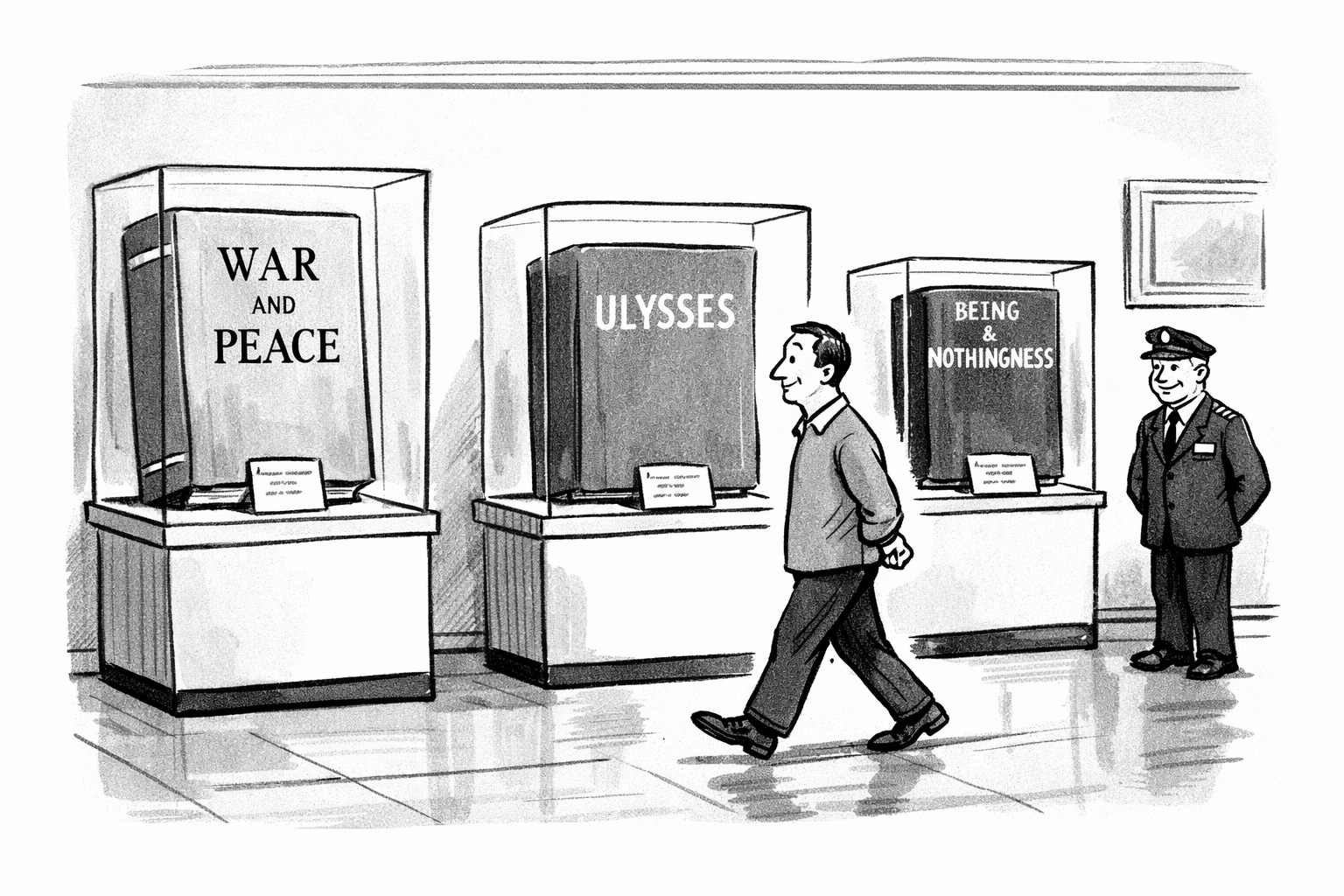
Repeat after me: my life will probably be better if I don’t force my way through War and Peace.
Here are some more examples of books to defer:11
Anna Karenina by Leo Tolstoy (more readable than War and Peace, but still long and dense. I’d recommend Madame Bovary first.)
Being and Nothingness by Jean-Paul Sartre
Capital in the Twenty-First Century by Thomas Piketty (no, your friends haven’t finished it either.)
The Decline and Fall of the Roman Empire by Edward Gibbon (historically important, but there are many better entrance points.)
Don Quixote by Miguel Cervantes
Finnegans Wake by James Joyce (I’m not sure this one even counts as being in English.)
Gravity’s Rainbow by Thomas Pynchon
Das Kapital by Karl Marx (of immense historical importance, but not the best contemporary entrance point into Marxist economics.)
The Magic Mountain by Thomas Mann
The Making of the English Working Class by E.P. Thompson
The Man Without Qualities by Robert Musil (it’s not even finished.)
Middlemarch by George Eliot (Victorian diction isn’t for everyone—especially not in a book this long, where the whole point is that nothing all that dramatic happens.)
Les Misérables by Victor Hugo (to quote Wikipedia: “More than a quarter of the novel—by one count 955 of 2,783 pages—is devoted to essays that argue a moral point or display Hugo’s encyclopedic knowledge but do not advance the plot, nor even a subplot.”)
Moby-Dick by Herman Melville (unless you specifically prefer your fiction to include long digressions about clam chowder.)
The Phenomenology of Spirit by Georg Wilhelm Friedrich Hegel
The Second Sex by Simone de Beauvoir (her essay The Ethics of Ambiguity is a much more concise option, as are the many works by later feminist thinkers who explain or build on it.)
The Sound and the Fury by William Faulkner
Ulysses by James Joyce (lots of arcane references—and besides, it’s a sequel.)
War and Peace by Leo Tolstoy (duh)
(The astute reader will notice that most of the above authors have works that are shorter and/or lighter—and in many cases, also better.)
Books that seem like they shouldn’t be as hard as they are
The list above consists mostly of works that are infamous for being hard.
But some books are trickier than that. Lots of people have read them, they’re widely loved, and they’re often talked about as if they’re broadly accessible. And yet they’re harder to get through than they appear, often because they demand a lot of patience up front, or because they’re dense with historical, cultural, or literary references that sail past many readers.
This is more pernicious than the previous category, because these books really seem like they should be easy to read. As a result, people tend to stick with them far longer than they should, or—worse—take failing to finish them as evidence that books just aren’t for them.
If you do want to read any of these, I’d recommend starting with lighter or more tightly plotted books in the same genre or by the same author, and saving them for a time when you’re in the mood to really sit with something.
Beloved by Toni Morrison
Dune by Frank Herbert (it hits you with a lot of world-building jargon right at the start.)
Guns, Germs, and Steel: The Fates of Human Societies by Jared Diamond (demands a lot of attention for a thesis that many specialists now consider overstated or disputed.)
If on a winter’s night a traveler by Italo Calvino
Mrs. Dalloway by Virginia Woolf (often recommended as “short” and “about everyday life,” but modernist interiority doesn’t go down easy if you’re not used to it.)
The Lord of the Rings by J.R.R. Tolkien (a similar issue to Dune: the payoff is great, but the beginning is slow.)
The Master and Margarita by Mikhail Bulgakov (it takes over a hundred pages to introduce its main protagonist.)
The Name of the Rose by Umberto Eco (it baffles me how well this sold—I assume because the blurb makes it sound like an elevated thriller rather than a compendium of historical references.)
One Hundred Years of Solitude by Gabriel García Márquez
Pale Fire by Vladimir Nabokov
Thinking, Fast and Slow by Daniel Kahneman (think of it more like a readable textbook. Also, the replication crisis has not been kind to some of the studies it leans on, even if the overarching ideas largely hold up.)
The Trial by Franz Kafka
Starter classics
I’ve tried to emphasize throughout this post that you really don’t have to read books that bore you just because other people like them.
But what if you have no idea what you like yet? What if you want to expand your horizons, but don’t want to get stuck on something that’s secretly far denser than it looks?
Below are a few classics that are genuinely fun to read and think about. I’ve tried to sample across genres, but stuck to fiction only. I’ve also limited myself to one book per author, even though many of these writers have other works that are just as readable.12 And to be clear, this isn’t meant as a reading list—just a set of reasonable entry points if you’re not sure where to start.
All Quiet on the Western Front by Erich Maria Remarque
Animal Farm by George Orwell
The Big Sleep by Raymond Chandler (try it for style and vibes even if you don’t think you like crime fiction.)
Choke by Chuck Palahnuik (if you’re under the misconception that “literary” books are always dry or pretentious.)
The Count of Monte Cristo by Alexandre Dumas (if you love long TV arcs and revenge plots, but assume old books must be slow.)
The Dispossessed by Ursula K. Le Guin (if you want big political ideas without being lectured at.)
Farenheit 451 by Ray Bradbury (try it for mood and pacing, even if you don’t think you like dystopian fiction.)
The Forever War by Joe Haldeman
Frankenstein by Mary Shelley
Gone with the Wind by Margaret Mitchell (if you want something long but very gripping and can tolerate (or critically read past) unfashionable politics.)
The Great Gatsby by F. Scott Fitzgerald (if you feel like symbolism or themes usually go over your head—and even if you were assigned it in school.)
The Importance of Being Earnest by Oscar Wilde (if you’ve never read a play before and/or you like comedies.)
Lord of the Flies by William Golding
The Metamorphosis by Franz Kafka
Of Mice and Men by John Steinbeck
The Murder of Roger Ackroyd by Agatha Christie
New Hampshire by Robert Frost (if you’re curious about poetry and want an entry point you can skip around in.)
Oedipus Rex by Sophocles (if you’re under the impression that older classics are boring, or if you just want a good drama.)
The Old Man and the Sea by Ernest Hemingway
The Painted Veil by William Somerset Maugham
Passing by Nella Larsen (if you assume older novels have archaic diction, and/or want a tight, dramatic plot.)
Pride and Prejudice by Jane Austen (even many people who don’t normally like romance enjoy this one for the satirical wit.)
Rebecca by Daphne du Maurier (if you love suspense and atmosphere but don’t usually read “literary” fiction.)
The Spy Who Came in from the Cold by John le Carré
The Strange Case of Dr. Jekyll and Mr. Hyde by Robert Louis Stevenson
The Stranger by Albert Camus (if you’re curious about philosophy but want it embedded in a story that’s blunt and spare.)
Happy reading!
In particular, you shouldn’t blindly copy the reading habits of people who read much more than you.
Maybe that’s because this is a much easier problem to fix? Not sure.
Yes, I’m sorry to say your English teacher was right, at least on this point.
I don’t listen to podcasts all that often, so take this with a grain of salt, but my favorite book-related one is Secret Life of Books. The hosts are good at placing books in a broader context, and while they clearly enjoy the books they read, they’re also comfortable acknowledging that even great books aren’t perfect.
I once read Lysistrata, a light comic play full of dick jokes, for a book club. All of us showed up with different translations, though mine was the only one with any jokes in it, genitalia-related or otherwise. Needless to say, I enjoyed the play more than some of the others.
This is particularly true for verse classics composed before people had access to this many books, like The Odyssey.
I know I flatter myself here, but my comments are open. (Seriously, I love giving personalized recommendations, and try to limit it IRL because it counts as unsolicited advice.)
We’re in a weird cultural place right now with LLM usage, so please excuse me if these tips are all incredibly trivial.
I’ve noticed that ChatGPT 5.2 often brings up The Death of Ivan Ilyich, The Go-Between, or The Remains of the Day, to name just a few examples.
I’m not saying any of these are bad or not worth reading. They’re just common books people force their way through and get very little out of.
Treasure Island and A Picture of Dorian Gray were the hardest to cut.